

Exclusive Services
It’s been theorised and studied for years and years; what does the human brain benefit from learning a musical instrument? Let’s firstly look at the brain as a muscle; the most important muscle in your body. Similar to how an athlete will go to the gym every day to strengthen their muscles, humans need to train and strengthen their brain. Many people approach this in different ways, some read challenging texts, others play cognitive brain games, some even learn a new language. However it is done, the brain needs to be fed in order to grow. Learning a musical instrument not only sustains and feeds the brain, but it also improves so many other cognitive and physical aspects of the human body.
1. Playing a Musical Instrument Improves Memory
2. Music Helps Relieve Stress
3. It Makes You Smarter!
4. It Can Build Your Confidence and Give You a Sense of Achievement
5. It’s Fun!
Electric Guitar Lesson

Most people that want to learn to play the guitar typically want to play the acoustic.
I started on an acoustic guitar myself. They sound better, you do not need an amp and you can take an acoustic to the beach, cottage or any party to play.
However, learning to play the guitar on an acoustic presents many challenges that can be eliminated or reduced by starting on an electric guitar instead.
Here are 3 reasons you should consider starting to learn the guitar on an electric instead of an acoustic.
1. It Reduces The Physical Requirements
An electric guitar is physically easier to handle and use. There is no possible argument here. Just compare any acoustic with an electric.
What does that mean for you when you are learning how to play the guitar? It means that you do not have to work harder to learn. You do not have to reach around the big body of an acoustic and can learn to relax while you play much sooner. This is very important.
You can focus on the other more important physical requirements of learning to play the guitar like forming chords and changing between them as well as strumming and coordinating the two.
What I find with most students is when they have an acoustic guitar they are often trying to get comfortable and changing positions instead of actually playing. This slows down your progress.
2. It Reduces The Amount Of Pressure Required To Play
This may not seem like an important factor but as a trained guitar teacher I assure you it is a very important aspect of learning to play the guitar.
Electric guitars have thinner strings and they are also setup to be much closer to the frets. That allows you to push them down with a lot less effort and make good contact and produce the right sound easier than you would on an acoustic guitar.
This is very important because using too much pressure leads to many problems.
Using too much pressure is the main cause of pain when you start to learn to play the guitar for example which is a common problem with most beginners.
But it can cause other problems like poor technique and bad habits that can cripple your ability to properly play things or to play them at higher levels.
Too much pressure will cause you to make much slower chord changes and to be very inconsistent and take you a long time to improve.
It may seem silly but starting to play on an electric guitar almost eliminates this for most people. It is definitely worth it if you can start this way.
3. You Will Progress Faster And Learn The Right Way
This is the main reason you want to start learning on an electric guitar instead of an acoustic.
Based on my experience teaching many people to play the guitar over the past several years I have seen with my own eyes the progress that people who start on an electric guitar make.
And if you think about it this makes sense. When you remove unneeded physical limitations from the equation you can focus on the actual skill development instead of trying to reach around the guitar or pressing the strings down.
The more focus you can give to proper finger placement, strumming and coordination of these two the faster you can master it and move forward.
This also means you are less likely to form bad habits and learn to play the right way.
The Best Part Is You Can Transfer Everything To The Acoustic Guitar
Once you learn a skill on the electric guitar it is then easy to transfer it to the acoustic guitar. It’s the same skill!!!!!
In my experience, most people are able to play their acoustic guitar properly much sooner if they start on electric. They tend to be more relaxed, have better habits and technique.
Because you will make faster progress on the electric guitar you will be more motivated and you will take less time, effort and frustration to learn to play.
The only drawback is that you need to have two guitars. Although for most of us guitar players this is not really a drawback. If you are not ready to buy an acoustic and an electric guitar many guitar stores will rent you an electric for a nominal fee so you can still do it.
It is definitely worth the extra investment!
extra investment!
Drum Lesson

7 reasons to learn to play drums
I often talk to you about how to learn to play drums on this blog: you have probably already read our articles about the different elements of a drum set, or how to hold your drumsticks properly. Nevertheless, you should still want to start learning how to play the drums! Whether you’re curious, want to start a new hobby, or are simply looking for a new activity for your children, you’ve come to the right article.
Learn how to play the drums is easy
We can never say it enough: drums are a fun, intuitive and above all, entertaining instrument! Very popular with young children, the drums allow them to let off steam while increasing their logical abilities, the synchronization of their limbs and concentration.
Increase self-confidence
It is difficult, especially at a young age, to have full confidence in personal abilities. Fortunately, the drums are a very powerful vector of confidence: they are an imposing instrument that allows you to constantly surpass yourself.
All you have to do is sit down and practice the instrument: progress and confidence come quickly.
Opening up to others
Learning to play the drums means opening up to others.
There are millions of drummers around the world.
Today, it has become extremely simple to discuss and exchange knowledge with an ever-growing community of drummers.
Make strong friendships
The music is very unifying.
It is very likely that once you have mastered the first drum rhythms, you will want to create or join a band. This is a normal feeling, and it is one of the strong points of music: creating links around the same passion, the same project. You will then make strong friendships and who knows, the most famous bands all started that way!
Bonus point: drummers are much sought after when forming a band. So keep practicing!
Learn how to play drums is quickly rewarding
Like any musical instrument, learning the drums requires a lot of work. The most stimulating thing is that this work is always quickly rewarded: progress is made quickly, and it is possible to have fun practicing the instrument very quickly. Moreover, there are no technical barriers: just be patient and diligent, and you will be able to do anything!
An instrument becoming more popular
If there is one thing that is a considerable advantage, it is that the drums are an instrument that is becoming more and more affordable. Financially speaking, there are drums in all price ranges. There’s also a choice that’s growing every day: acoustic drums, electronic drums, and now Senstroke sensors, which allow you to play drums without drums. The options available to you when you want to learn the drums are constantly evolving and diversifying, so it’s up to you to choose the one that suits you best.
A lifetime passion
When you’re officially a drummer, it’s for life.
You won’t be able to live without your instrument.
So obviously, you will have to keep practicing if you want to stay at your best level. But it is completely possible to start at any age and continue your whole life. Even better, you’ll be able to pass on this passion to the world by sharing your exploits on social networks, and you’ll continue to progress thanks to your open-mindedness and curiosity.
In conclusion
Learning to play drums, and more generally to play a musical instrument, is a step that few people manage to take for different reasons: lack of time, motivation, money…
Nevertheless, we live in a blessed era for the practice of an instrument. Information on the Internet, lower costs of instruments, mutual help and lessons online or in schools: it’s up to you to get started!
Until then, take care of yourself and keep on drumming!
Ukulele Lesson

Most people that want to learn to play the guitar typically want to play the acoustic.
I started on an acoustic guitar myself. They sound better, you do not need an amp and you can take an acoustic to the beach, cottage or any party to play.
However, learning to play the guitar on an acoustic presents many challenges that can be eliminated or reduced by starting on an electric guitar instead.
Here are 3 reasons you should consider starting to learn the guitar on an electric instead of an acoustic.
1. It Reduces The Physical Requirements
An electric guitar is physically easier to handle and use. There is no possible argument here. Just compare any acoustic with an electric.
What does that mean for you when you are learning how to play the guitar? It means that you do not have to work harder to learn. You do not have to reach around the big body of an acoustic and can learn to relax while you play much sooner. This is very important.
You can focus on the other more important physical requirements of learning to play the guitar like forming chords and changing between them as well as strumming and coordinating the two.
What I find with most students is when they have an acoustic guitar they are often trying to get comfortable and changing positions instead of actually playing. This slows down your progress.
2. It Reduces The Amount Of Pressure Required To Play
This may not seem like an important factor but as a trained guitar teacher I assure you it is a very important aspect of learning to play the guitar.
Electric guitars have thinner strings and they are also setup to be much closer to the frets. That allows you to push them down with a lot less effort and make good contact and produce the right sound easier than you would on an acoustic guitar.
This is very important because using too much pressure leads to many problems.
Using too much pressure is the main cause of pain when you start to learn to play the guitar for example which is a common problem with most beginners.
But it can cause other problems like poor technique and bad habits that can cripple your ability to properly play things or to play them at higher levels.
Too much pressure will cause you to make much slower chord changes and to be very inconsistent and take you a long time to improve.
It may seem silly but starting to play on an electric guitar almost eliminates this for most people. It is definitely worth it if you can start this way.
3. You Will Progress Faster And Learn The Right Way
This is the main reason you want to start learning on an electric guitar instead of an acoustic.
Based on my experience teaching many people to play the guitar over the past several years I have seen with my own eyes the progress that people who start on an electric guitar make.
And if you think about it this makes sense. When you remove unneeded physical limitations from the equation you can focus on the actual skill development instead of trying to reach around the guitar or pressing the strings down.
The more focus you can give to proper finger placement, strumming and coordination of these two the faster you can master it and move forward.
This also means you are less likely to form bad habits and learn to play the right way.
The Best Part Is You Can Transfer Everything To The Acoustic Guitar
Once you learn a skill on the electric guitar it is then easy to transfer it to the acoustic guitar. It’s the same skill!!!!!
In my experience, most people are able to play their acoustic guitar properly much sooner if they start on electric. They tend to be more relaxed, have better habits and technique.
Because you will make faster progress on the electric guitar you will be more motivated and you will take less time, effort and frustration to learn to play.
The only drawback is that you need to have two guitars. Although for most of us guitar players this is not really a drawback. If you are not ready to buy an acoustic and an electric guitar many guitar stores will rent you an electric for a nominal fee so you can still do it.
It is definitely worth the extra investment!
Cello Lesson
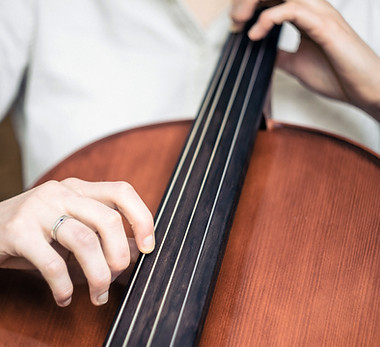
Reasons Why You Should Learn to Play the Cello
Endless solo options
If you opt for the cello over other instruments, you will have more solo options to enjoy than the average musician. The list of solos that one can choose from is endless as almost all well-known composers including Bach created solo pieces specifically for the cello.
To build your physical strength
Granted, playing the cello will not produce the same results that cardio will, but it certainly has some physical benefits. First and foremost, the cello is not a small instrument- it requires physical strength to move it from place to place, which can be great for your physique. Also, although the player has to be seated when playing the cello, the muscle movements needed to support the cello properly and to execute the various bowing techniques consequently helps to improve one’s posture, as well as enhance upper body strength.
Ideal for young students
Anyone can learn how to play the cello, but it is especially recommended for young players. Young students make excellent cello students because youth typically comes with the enthusiasm for learning a new instrument. Because young minds are also characterized by mental elasticity, it means that younger players tend to absorb new learning material faster than the older ones. Adult players also have their own sets of advantages such as enhanced control but it is always advisable to take up an instrument early on when one is still young.
It has an impact on your cognitive process
Learning how to play the cello is a comprehensive venture that incorporates all sorts of learning styles such as auditory, visual and kinaesthetic learning styles that make it easy to concentrate. The more one practices, the more one’s brain develops new connections that can be replicated in other areas of learning such as mathematics. Playing the cello also strengthens other cognitive processes such as coordination and multitasking, which are skills that are beneficial in real life.
To enrich your memory
The cello is an extraordinary instrument that can also be quite rewarding. The process of learning the cello requires extensive comprehensive learning which in turn does wonder for your memory. By combining various mental exercises in a structured manner, the process of learning actually stimulates and strengthens certain areas of your brain such as memory and comprehension. Moreover, learning the cello stimulates and creates connections that last all through adulthood.
It is extremely marketable
The cello is not the simplest instrument to learn, but when mastered, it can present an individual with a lot of professional opportunities. Mastering the instrument such as the cello requires complete dedication and the development of certain skills such as a keen sense of timing and the ability to work in a team. If you choose not to pursue the cello professionally, skills such as these that are intangible can also be valuable in the market place.
The cello is versatile
The cello is one of the most versatile instruments there is. Unlike most other instruments, the cello has the uncanny capacity to produce a really high note one minute and can sink to the lowest notes in the next. The cello’s versatility is largely the reason why it can be utilized in all sorts of musical genres including electronic, contemporary, rock, and so on and so forth.
It produces the best sound
Musicians have long agreed that the cello is one of the only instruments that mimic the human voice well. The sound produced by the cello is not as high pitched as the violin and it is not low like the bass. Instead, the cello produces a sound that is deeply layered and rich, which helps to explain why it is so popular among classical musicians. Owing to its middling range, it is often reserved for the richest and warmest parts of the orchestra.
It is good for you
Playing the cello allows you to escape the hustle and bustle that comes with contemporary life. For instance, the cello can serve as a therapeutic tool when one is having a bad day and it can also be a wonderful form of stress relief. When playing, it is easy to quickly immerse yourself into the experience so it can also be a wonderful form of meditation and relaxation
Voice Lesson

5 SIGNS YOUR CHILD IS READY TO START SINGING LESSONS
Outside of the basic physical requirements, here are some signs that your child is ready to take up singing.
Your child is motivated to sing. Students who are motivated progress at a much faster rate and have more success learning an instrument. If the child enjoys music or sings along to the radio or TV programs, this is a good indication that they are ready to start learning how to sing.
-
Your child can focus for 30 minutes. Consistent practice is the key to learning to sing. If your child can focus on a task for 30 minutes, they should be able to maintain a practice schedule and be able to handle taking singing lessons.
-
Your child can make time to practice singing. In addition to lessons, students need practice time throughout the week in order to learn to sing. Parents may need to help manage practice time, especially at first, when the student is new to singing.
-
Your child is mature enough to commit. Children can vary pretty widely by age in terms of their social maturity. If the child is able to follow directions well and takes to coaching, they will have more success following their teacher’s instructions. More mature students can also self-manage their practice time.
-
Your child has the patience to work with any speech impediments. Students with speech disorders may find it a little frustrating when first starting singing lessons. However, learning to sing in lessons with a supportive instructor can actually help these issues over time and give students newfound confidence.